

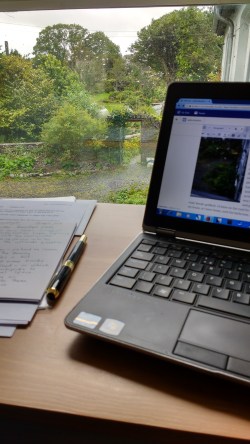
 The view from the window of my little room.
Many thanks to last week’s guest blogger Joshua Palmatier for doing a post for me while I was away at Milford SF Writers’ week in Snowdonia at the lovely Trigonos, Though they do have wi-fi there now, it tends to be intermittent, so I wasn’t sure how much connectivity I would have. Also I was working on my little Dell laptop, bought (reconditioned) for travelling. It’s nowhere near as convenient as my desktop machine which has a 23 inch monitor and a lovely clicky keyboard.
What’s Milford?
Milford is practically an institution in it’s own right. It was started by a bunch of well known, well respected professional SF writers in Milford Pennsylvania in 1956. Damon Knight being one of the prime movers. James and Judy Blish brought it to the UK in 1972 and with only a couple of…
View original post 570 more words
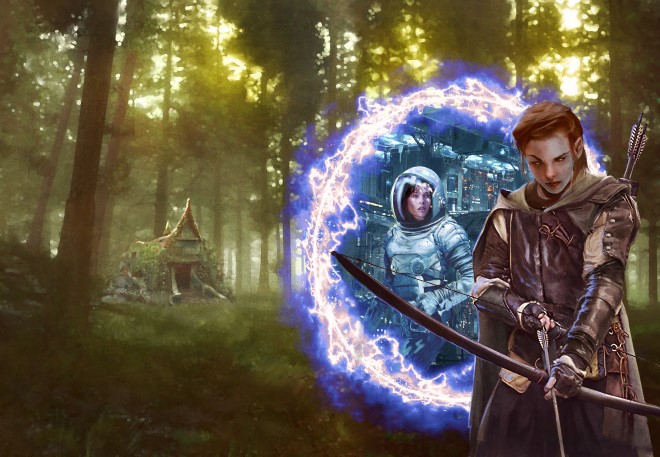 First, the lead anthology, which is really my own little baby. I grew up reading fantasy novels in the 80s, which means I read a ton of novels with characters from our world transported to another world. Books like Andre Norton’s WITCH WORLD or Stephen Donaldson’s CHRONICLES OF THOMAS COVENANT. There were many, many others, but I noticed that I hadn’t seen or read many “portal novels” in either fantasy or sci-fi recently. I loved those stories, so thought, “Why not do an anthology with portals as the theme?” Hence, PORTALS was born (although…

 In what I can only describe as a courageous decision, I spent part of a recent weekend cleaning out the drawer of half finished projects. Perhaps it was the sun. And there were more than I remembered there being. So one of the things this cleaning out has inspired me to do is to see how many of them I can convert from half finished to finished by the end of the year.
 First off, I’ll pepper these words with caution. This is how I do things. You might have a much better way of selling stories to anthologies. And if you do, could you please tell me in the comments.
 I recently contributed to an anthology of women’s SF published by a think-tank (doteveryone, helmed by Martha Lane Fox) and they very kindly gave me a free ticket to an event in Wapping: Futurefest 2018.
 Imperial College has been running an annual event, Science for Fiction, for the last few years and many members of Milford have not only attended, but have found this to be an invaluable resource in terms of inspiration and information for their fiction. Run by Professor David Clements, himself a Milford regular, the event runs over 2 days and consists of a series of lectures and discussions on cutting-edge science. In the past, attendees have learned about epigenetics, ethical issues in AI, and tried out a VR device simulating the Mars rover.
 Imperial is one of the top scientific institutions on this planet, a world-leader in physics, astrophysics and AI. It’s fundamentally an engineering college, but some researchers (for instance, Marek Sergot in the AI department) are involved in exploring ethical issues within their fields. Robotics is a major focus and Imperial is involved with the European Space Agency; an…

