

We all have our ways of doing things. When I’m plotting out a novel or a longer story I always start with pen and paper. I like to use my favourite fountain pen, and quartered sheets of A4. I do something similar with a short story too, though I’ll probably just write down a few key things that anchor it. I’ll always use pen and paper.
 There’s something about the process that works well for me, though I don’t know why. All I can say is there’s a connection between mind and eye and hand so they feel like three parts of one thing. Pen and paper stimulates and focusses my imagination and lets the ideas flow – though not in any order. I’ll brainstorm everything in a few sessions, one plot point, or scene, or character, or piece of dialogue per piece of paper. I’ve found this much more…
View original post 384 more words
 Have you ever noticed that the more constraints you face in your writing, the more creative you become? I used to write a collage piece with a group of writers—just for fun, you understand. This involved the giving and receiving of short phrases from everyone in the group, so that you end up with perhaps six unrelated phrases to work with. If working alone, you can choose random words/phrases from the book you are currently reading. The challenge then is to write a piece that incorporates all the phrases within ten minutes. As an additional constraint pick one of the phrases to start and finish the piece with.
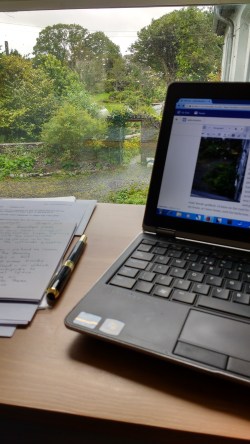 The view from the window of my little room.
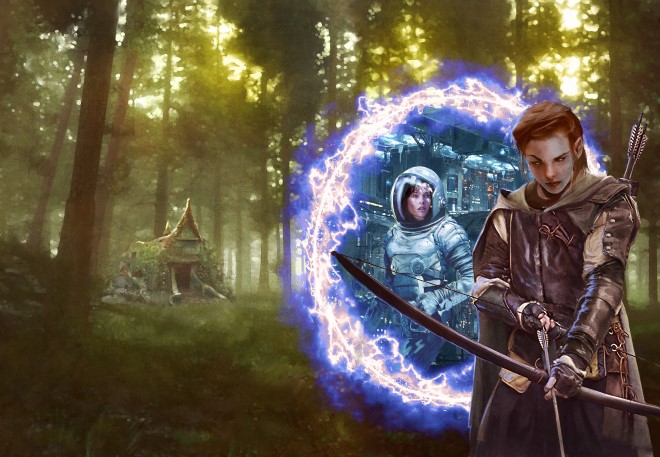 First, the lead anthology, which is really my own little baby. I grew up reading fantasy novels in the 80s, which means I read a ton of novels with characters from our world transported to another world. Books like Andre Norton’s WITCH WORLD or Stephen Donaldson’s CHRONICLES OF THOMAS COVENANT. There were many, many others, but I noticed that I hadn’t seen or read many “portal novels” in either fantasy or sci-fi recently. I loved those stories, so thought, “Why not do an anthology with portals as the theme?” Hence, PORTALS was born (although…


 In what I can only describe as a courageous decision, I spent part of a recent weekend cleaning out the drawer of half finished projects. Perhaps it was the sun. And there were more than I remembered there being. So one of the things this cleaning out has inspired me to do is to see how many of them I can convert from half finished to finished by the end of the year.
 First off, I’ll pepper these words with caution. This is how I do things. You might have a much better way of selling stories to anthologies. And if you do, could you please tell me in the comments.
 I recently contributed to an anthology of women’s SF published by a think-tank (doteveryone, helmed by Martha Lane Fox) and they very kindly gave me a free ticket to an event in Wapping: Futurefest 2018.
 Imperial College has been running an annual event, Science for Fiction, for the last few years and many members of Milford have not only attended, but have found this to be an invaluable resource in terms of inspiration and information for their fiction. Run by Professor David Clements, himself a Milford regular, the event runs over 2 days and consists of a series of lectures and discussions on cutting-edge science. In the past, attendees have learned about epigenetics, ethical issues in AI, and tried out a VR device simulating the Mars rover.
 Imperial is one of the top scientific institutions on this planet, a world-leader in physics, astrophysics and AI. It’s fundamentally an engineering college, but some researchers (for instance, Marek Sergot in the AI department) are involved in exploring ethical issues within their fields. Robotics is a major focus and Imperial is involved with the European Space Agency; an…

