

A comedy panel at Eastercon 2018 with Jaine Fenn (moderator), Juliet McKenna, Adrian Tchaikovsky and Jacey Bedford.
Uncategorized
Imprecise Words and Their Allies by David Gullen
 I have fulminated about this at least once before. I’ve been doing a fair amount of critical reading recently and while my opinions on many things have changed over the years the ways some words are used still bug me for the same reasons. Here are a few of them and why they rattle my cage.
Almost, Seemed, Appeared
Pwimula Nesbytt pulled the saddle from Bismarck, her faithful battle-mole. She seemed to be upset about something.
Only seemed to be? And only about something. Do we care, do I need to worry? Either Pwimula is upset, or she isn’t. If she isn’t, don’t mention it. If she is, then you should say so, say why, and describe how she is upset – angry, tearful, irritated. Not doing so creates a false tension that implies the author, rather than the characters, is uncertain about what is happening.
Pwimula brushed away a…
View original post 620 more words
Are You a Plotter, a Pantser — or a Puzzler? By Ruth Nestvold
Most writers have heard the question before: “Are you a plotter, or are you a pantser?” In other words, do you do a lot of outlining and planning before you start writing (plotters), or do you dive into a project with little or no pre-writing and write “by the seat of your pants” (pantsers)?
 I was never completely comfortable with either term. On the one hand, I always knew I was more of a plotter than a pantser. Some of my writer friends can take a couple of prompts and immediately start writing. Pantsers barrel into the story and go for it, letting plot and character unfold as they write. For many of them, part of the magic of writing is discovering the story as they go. My late friend Jay Lake was a master pantser, and it baffled me how he could whip up a story out of little…
View original post 927 more words
Milford Writers’ Retreat 2018 – by Jacey Bedford
 The Milford committee has kicked around the idea of a writers’ retreat before, but this year we finally got around to organising one when we received an email from Trigonos advertising their spare winter dates. There was an enticing six day period from Sunday 25th Feb to Saturday 3rd March, and we snapped it up.

Trigonos is pretty well perfect for a retreat. It’s not just the setting, which is gorgeous, but also the ambiance. Ensuite rooms with writing tables, a lovely library (with an open fire) for communal chat, excellent food, and a ‘we’re here to help, but we’ll leave you alone if that’s what you want’ kind of attitude. After the evening meal the staff all go home and we’re left to our own devices, so it’s very homely.
Breakfast at eight, coffee and biscuits at eleven, lunch at one (with delicious home made soup). Four p.m. is…
View original post 431 more words
Ideas and where to find them – by Jaine Fenn
Earlier this week I was asked a question which may evoke a wry smile amongst fellow writers: ‘Where do you get your ideas?’I will be honest: my usual response to this old chestnut of a question tends towards glibness.
Sometimes I quote a response attributed to Asimov: ‘I just leave out milk and cookies overnight, and in the morning the milk and cookies are gone and there’s an idea there.’ Or, to put it another way, buggered if I know.
Sometimes I quote the late great Sir Terry Pratchett: ‘I don’t know where ideas come from but I know there they go: they go to my desk, and if I’m not there, they go away again.’ Or, to put it another way: what appears to have happened by magic to you, dear reader, is actually the product of a lot of hard work.
But this question was asked with…
View original post 523 more words
Vector’s pick of science news in 2017

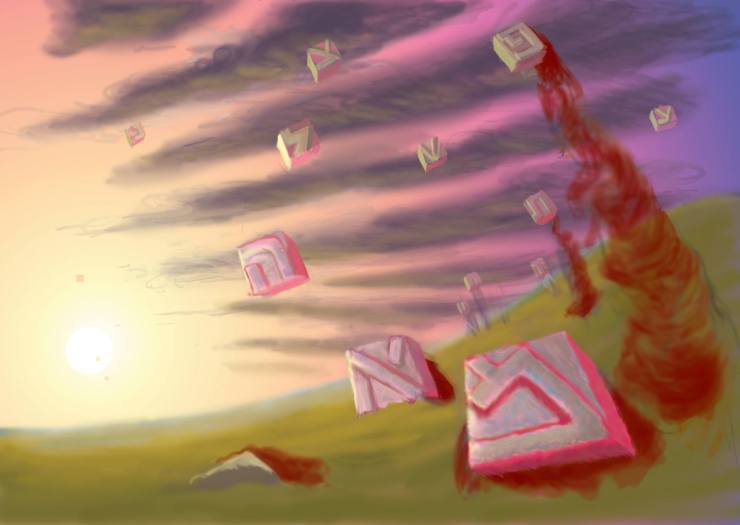 ‘Transdimensional’ by Phil Jones
In the spirit of Vector’s traditional “Best of” print edition, which is nearly ready, here is our pick of science news for 2017.
First of all, water. Two new inventions for increasing the supply of drinking water caught our eye:
- one, using a graphene-enhanced membrane for desalination
- and another, using sunlight in a device that pulls water out of the air.
In other exciting news regarding fluids, albeit less immediately applicable: scientists have made a fluid with negative mass. But then, the usefulness of inventions is often hard to judge.
The New York Times is not a place where one expects to find encounters between the Navy and UFOs, but the NYT in 2017 has been a place to rival any dystopian SF. Therefore, it has been worth the extra effort to look for technoscience news which seemed less likely to transform our world in…
View original post 277 more words
Imposter Syndrome – Embrace the Experience by David Gullen
Writers all over the world talk about Imposter Syndrome*, that feeling your success is undeserved and that one day the world will collectively blink, take a good long look at you and realise you are some kind of fraud.
 It’s something that affects people in many walks of life, creative or not. You would think it should be a simple thing to look at your own achievements and accept the success that years of experience, hard work, and learning, have brought. For many people it’s not always so. I’ll admit to being one of them. I don’t think my writing is good enough, I try with every piece I write to be a better writer. It’s the same with my leather-craft and, even though I can see the results and know I’m getting better, on some days I still feel like I’m an amateur.
I love our garden and…
View original post 376 more words
Four things I learned from going to Milford by Al Robertson
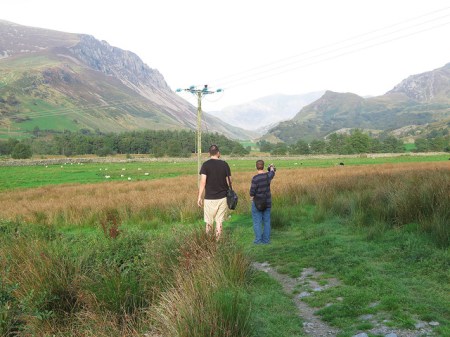
Over the years, I’ve had a wonderful run of Milfords; I was lucky enough to read and critique some excellent stories, and to have my own stories deftly critiqued by a wide range of knowledgeable, thoughtful readers. I learned some very important things while doing that. Oh, and I’ve (mostly) illustrated this post with pictures taken in the countryside around the Trigonos Centre, where Milford talks place.
 Company matters more than you’d think
I once took a week to go and write in Devon, in a house where I’d be completely alone in a quiet little village where I didn’t need to see anyone. I thought it would be an insanely productive week; instead, I just nearly went insane. Of course, everyone works differently – but I found out that, for me, if I’m going to be writing I also need to be not-writing. I need to be feeding the…
View original post 833 more words
Post-Cyber Feminist International

 Post-Cyber Feminist International, Glitch@Night BBZ London (Photo: Mark Blower)
‘A particularly gendered set of obstacles emerges from the contemporary ubiquity and commodification of the digital sphere. From sexual harassment and privacy to issues surrounding divisions of labour, the progress of gender justice has in some ways failed to keep pace with the dizzying velocity of digital developments. At the same time, new networked technologies have come to dominate the horizons of critical discourse, pushing older and more quotidian devices to the margins of cultural visibility. And yet, these domesticated technologies (from the Hoovers to HRT) continue to exert a shaping influence on many people’s everyday lives. It is critical that feminists find new ways of interrogating technologies in order to forge a radical gender politics fit for an era in which the analogue and the digital are inexorably intertwined’ [ICA]
 Black Feminism and Post-Cyber Feminism (Photo: Mark Blower)
View original post 311 more words
From Our Archive: Nisi Shawl
This article first appeared in Vector 247.
Colourful Stories
Fantastic Fiction by African Descended Authors, by Nisi Shawl
 So rich a sea, so broad the currents … in exploring fantastic literature by African-descended authors, where do we start?
“Begin at the beginning” is standard advice for writers. “Begin where you are” is more my style. Where I am at the moment, where I’ve been most of my life, is North America. Though I know there are many other schools of African-descended writers out there, myriad fabulists swimming in gorgeous array, I’m at my best talking about those with whom I’ve had the most contact, those about whom I have something substantial to say: those who inhabit the Western Hemisphere. In the course of this essay, then, I’ll focus on “New World” writers of fantastic fiction whose ancestors came from Africa. I’ll talk about specific works by them and also touch…
View original post 3,537 more words

